
- What's the role of photo journalism?
*1
 *2 (Battle for Libya)
 *3 (Battle for Libya)
 *4 (Devastation in Japan)
- Are there rules that photojournalists should follow? Why? Why not?
There are rules that photojournalists should follow. "Photojournalists should follow the general journalistic codes of ethics, but there are no laws or strict regulations that police the work of the media." (Icevska) Almost all rules are based on self regulations and code of ethics created by journalistic organization.
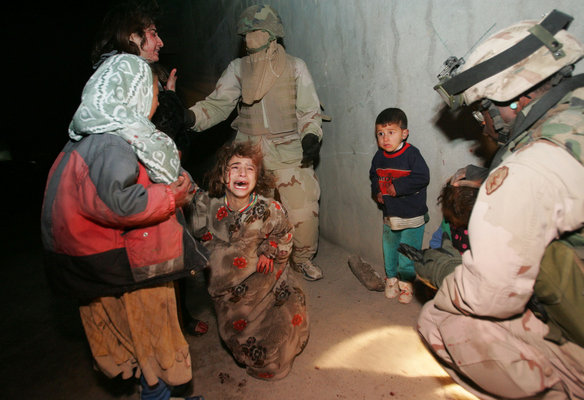
The reason why photojournalists should follow ethics rules is preserving the credibility of visual journalists. If they do not follow the rules, they will lose their credit from the audience. However, those rules are mainly dealing with photo alternation, thus it still has some ethical behaviour issues. For example, Kevin Carter who was an award-winning South African photojournalist and member of the Bang-Bang Club is the good example.He described reality of the situation though his photograph, but people asked him " before you took a picture, why you did not help the little girl?". He as a photographer took a good picture which describes reality of that moment, but his action, did not help little girl, was probably not ethically appropriate behaviour.
 *5
*5
 *6
*6
- Is the ethics of taking journalistic photos different than the ethics of writing a news story?
There aren’t any differences between ethics of taking journalistic photos and the ethics of writing a news story. Both photojournalists and news writers are responsible for providing the accurate and honest facts that have happened around the world to the readers and community.
According to the article by Dillon Westbrook, “The photojournalist must be careful not to exclude important parts of the context of the event being photographed”
- What's the impact of altering press photographs? Should they be edited (at all) in postproduction?
Since the role of photo journalism is sending the truth, if it is altered, it will lost its original sense and it can mislead viewers, misrepresent subjects and creates a false impression. Therefore, “Most of the media around the globe believe that photography in the media should receive the same treatment as words: no manipulations in any ways are allowed” (Icevska), but mean while, they agree that “the only acceptable changes are those used to improve the quality of the photograph, but without changing the context/facts on the photograph in any sense.” (Icevska). In addition, there are no international ethical regulations toward alternation, thus, “each of the media decides where to draw the line. Some media have stricter rules than others.” (Icevska). For example, most of the news organizations ban colour adjustments. Thus, “In 2006, a Charlotte Observer photographer was fired for changing the colours on his photograph. But the Toronto Star code of ethics allows colour to be changed. According to their code of ethics “these adjustments and enhancements should be used with great care and should not alter the integrity of the image” (Icevska). In summary, altering journal photography can be allowed to edit in some way if it not lose the fact on photography and it should be clearly labeled as reenactment.
By Seong Jin Bae, Min Kyoung Shim and Satomi Takusari
References
Icevska, Gordana S. "Shooting the truth: how photographs in the media betray us." n.d.
Tomilinson, Elizabeth. "Photojournalism Ethics." 16 December 2010. CJ222 News Reporting & Writing. 14 March 2011
Westbrook, Dillon. "A Brief History of Photojournalism." Photography Schools. 14 March 2011
*4 http://l.yimg.com/bt/api/res/1.2/0FPm.8dE_DS2QzqfkLY7ew--/YXBwaWQ9eW5ld3M7Zmk9aW5zZXQ7aD0zMDA7dz00NTA-/http://media.zenfs.com/en_us/News/Reuters/2011-03-13T213915Z_01_NOOTR_RTRMDNP_2_India-555425-1-pic0.jpg
*5 http://journalistjan.files.wordpress.com/2010/12/sad-1.jpg?w=640&h=421


No comments:
Post a Comment